












While Trinny London is not even a decade old, the beauty retailer has gone from being makeup-focused and digital first, to now focusing on omnichannel with its flagship London store and personalised services.

Skincare was introduced in 2022 and now makes up almost half of the business, and the retailer reported £70m in revenue in March 2025.
Its managing director Mark Smith, who has extensive experience through Evans Cycles, Sweaty Betty and restaurant chain Pho, was brought on in September 2023 to grow the business beyond £50m with long-term aspirations of reaching £200m-£250m.
Smith spoke to Retail Week about how the store experience and online retail work cohesively together, its over 45+ demographic, and why it’s taking Christmas gifting seriously now.
What’s the approach to omnichannel at Trinny London?
“We didn’t have a store when I joined. Step one was defining the purpose of a store and I’m passionate about how the web and retail work hand in hand. People tend to be loyal to a channel as there are brands you shop online and others you shop in-store, but few where you cross channels.
“Online, we do a lot around personalisation, but there’s only so much you can do digitally. Bringing products to life and offering personal advice and assessing if your skin is really dry requires an in-person experience and demystifies any confusion. A store shouldn’t just be shelves of products you can order online for next-day delivery, it should bring the brand to life.
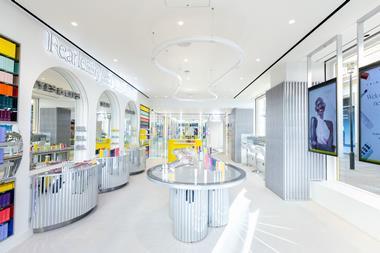
“Our King’s Road flagship was designed to showcase everything we stand for. Other locations in department stores are naturally constrained by being in the retailer’s environment and you can’t do everything you want. The flagship is everything we want to deliver, and then we try to scale that for spaces in Liberty or John Lewis stores.”
So, is the majority of the business online?
“Yes, around 70-75% of our retail is online, but we need to make that experience as easy as possible. For makeup, personalisation is key. Our ‘Match2Me’ tool really helps customers choose the right shades but even after using it, some people still want to see the shade on themselves or get advice in person. That’s where stores come in.
“Historically, retailers judged stores purely on profitability – profitable stores were good, loss-making stores were bad. I think that’s nonsense. If a profitable store only moves customers from online to in-store, that’s not great for the brand. Maybe the loss-making store has doubled the number of customers shopping on the web in that region because of the awareness and presence. We’ve got to look at how stores and online work together as one ecosystem. The experience should feel consistent across channels, while offering the added benefits of being physically present.”
What about pop-ups? Do they help you define what you want customers to see?
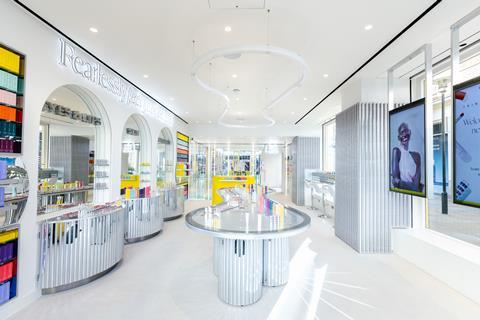
“Pop-ups are about building brand awareness, not about how much money we take. We’ve done pop-ups in New York and Boston and we look at how many customers we got and if they are continuing to shop here. Those are the important metrics.
“The US is a test market for us, but in the UK and Ireland, we want locations within all the major retail centres in places like Leeds and Liverpool so it’s accessible to everyone.”
“Once they discover us, they stick around because the products deliver”
Explain a bit about Trinny London’s customers and what they can expect.
“Our typical customer is 45+, a demographic underserved by the beauty industry, which focuses on millennials and Gen Z. Our customer has more money to spend, is busy, going through life changes, and wants simplicity. We can service and support that woman and we’re not trying to appeal to 25 year olds with completely different priorities to a 45 year old.
“Personalisation has been core to Trinny London from the start. We’re trying to develop that and push that further. Our ‘Match2Me’ tool helps customers find the right shades and routines easily. Other brands are only just starting to think about personalisation, often in a tokenistic way. There’s so much we can do with AI and technology to make the experience even more tailored. Imagine seeing models that look like you on product pages trying on your shade – that’s a huge way we can move forward.”
How do you balance attracting new customers while keeping loyal ones?
“By staying authentic. New customers look like our existing ones so we’re not trying to pivot to a completely different demographic. There are plenty of women out there who fit our profile. The challenge is awareness – many know Trinny Woodall from TV, but how many know what Trinny London stands for as a brand? Once they discover us, they stick around because the products deliver.”
Christmas is coming. What are your priorities for the season?
“At this point, you hope you’ve done the hard work and now it’s about trading. The beauty market has seen brutal discounting recently with some businesses struggling and others up for sale. We try to avoid heavy discounting, and we’re lucky we can make that decision without shareholder or City pressure.
“Where we’ve really improved is gifting. We didn’t take Christmas gifting seriously before, but this year we’ve nailed it. We’ve got fabulous gift sets and a fun campaign and I’m excited to see how well it performs now that we’ve done it properly.”




No comments yet