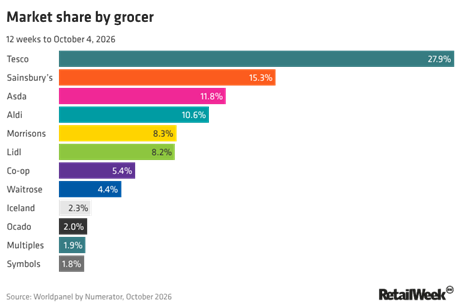
Latest Worldpanel grocery market share data
Who is actually left running the Co-op?
With the Co-op’s chief digital and technology officer becoming its latest high-profile departure, Retail Week asks: who is left running the retailer?
Worldpanel compiles its monthly snapshot of the UK grocery market by analysing the household grocery purchasing habits of 30,000 British households. The data Worldpanel collates is based on the value of the items purchased by those consumers. Tesco holds a strong advantage as Britain’s largest grocery retailer, with Sainsbury’s, Asda and Morrisons making up the so-called ‘big four’. However, value players Aldi and Lidl have closed the gap to the established order considerably having grown their respective market shares at a pace following the 2008 financial crisis. The discount duo hope to make further gains in the post-covid-19 recession.
With the Co-op’s chief digital and technology officer becoming its latest high-profile departure, Retail Week asks: who is left running the retailer?
Advertisement
Sales picked up and price rises slowed to their lowest rate since 2024 in the four weeks to 12 July, a month shaped by record temperatures and a packed sports calendar.
Unit growth at grocery retailers was up by 1.1% year on year in the four weeks to July 11, NIQ has reported, in the strongest volume performance of the last 12 months barring Christmas and Easter
Grocery inflation slowed again in June as record temperatures in May helped drive grocery sales.
As today’s Worldpanel grocery market share data showed Lidl overtaking Morrisons, Retail Week analyses whether this is a seismic moment for UK grocery, or will come to be seen as a statistical footnote in all but the most niche histories?
There is a new member of the grocery top five and why the quarterly retail sales trends are important.
Grocery inflation eased in early May, as discounter Lidl’s consistent growth saw it finally leapfrog supermarket chain Morrisons.
Like-for-like grocery inflation held at 4.3% for the second month in a row, Worldpanel by Numerator said, though financial anxiety is running high in the UK.
Take-home grocery sales went up in February, as a wider number of customers chose to shop online.
Sainsbury’s has today (February 13) announced that its premium Taste the Difference range has surpassed £2bn in sales.
Take-home grocery sales grew in January, as grocery price inflation eased at the start of the year, offering customers some relief.
Asda was the only major supermarket to see its sales fall ahead of the crucial Christmas trading period.
Supermarket sales rose in October, when consumers prioritised value for money as they scooped up cut-price offers.
Meat, coffee and chocolate are driving up till prices, according to the latest figures from Worldpanel by Numerator, covering the four weeks ending October 5.
Grocery price inflation nudged down slightly and take-home sales grew as discounter Lidl came close to overtaking Morrisons’ market share.
Grocery footfall hit a five-year high in early June as customers resorted to shopping little and often as grocery prices and temperatures spiked.
Aldi is recruiting for 1,000 new store roles as it ramps up its new store openings programme before the end of the year.
Aldi has overtaken Asda to become the UK’s third-largest supermarket by grocery market share.
Despite a sizeable jump in grocery inflation over the period, customers were still willing to spend big on Easter this year.
Take home grocery sales in January jumped, driven by a surge in customer spending on promotional products and on healthy food and alcohol-free drinks.
UK grocers have continued to invest in lowering the prices on essential grocery items over the past month as food inflation inched up ahead of the October Budget.