






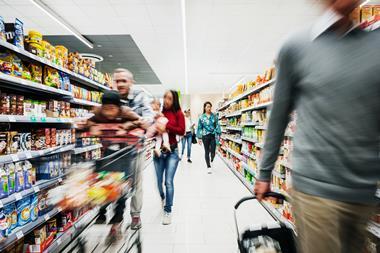
Like-for-like grocery inflation held at 4.3% for the second month in a row, Worldpanel by Numerator said, though financial anxiety is running high in the UK.
The figures, covering the four weeks to March 22, 2026, also showed that take-home sales at the grocers increased by 4.4% compared to the same period in 2025.
Grocery price inflation as measured by Worldpanel by Numerator rose to its current figure of 4.3% last month, having hit a nine-month low of 4% in January. Farmers and food producers have warned that the war in Iran is likely to increase the cost of food in part thanks to higher fuel and fertiliser prices.
While there is no significant sign of that yet, Worldpanel by Numerator said that 20% of Britons described themselves as financially struggling, with over 60% saying they were very or extremely concerned about the rising price of groceries in a January survey.
Yesterday, the Institute of Grocery Distribution warned that food-price inflation could increase to 8% by June 2026, in the “most severe but short-lived energy shock scenario”.
Asda executive chair Allan Leighton said last week that he believed the conflict would create inflation and called for government revenue from fuel duty to be redistributed for “supporting farmers in some shape or form”, The Guardian reported.
“Shoppers will look to lessen the impact on their baskets when faced with rising prices, and while there remains a level of uncertainty, we are watching the data closely for behavioural changes like trading down and switching, which often emerge during periods of economic pressure,” said Worldpanel by Numerator head of retail and consumer insight Fraser McKevitt.
One of the products that has seen the fastest rise in prices over the last few years has been chocolate. Despite the pace of chocolate price inflation slowing again to 8% from 9.3% last month, the average price of an Easter egg is 9% higher than last year at £3.27.
“Despite this, there is no sign of shoppers choosing smaller eggs though, with an average weight of 162g, a marginal increase on last year,” said McKevitt.
Just over 40% of shoppers bought at least one pack of hot cross buns in the four-week period tracked, while 30% had already purchased an Easter egg.
Grocery market shares
Over the 12 weeks ending March 22, 2026 Lidl increased its market share by 0.5 percentage points, a faster rise than any other grocer. Its market share is now 8.3%, the same as Morrisons, with the latter’s till roll is now just £8m higher.
Sainsbury’s attracted a higher number of new households than any other grocer, welcoming 387,000 more customers than in the same 12 weeks a year before. This led to a market share gain of 0.3 percentage points to 15.6%, an increase that was also matched by Britain’s largest grocer Tesco, which finished on 28%.
Asda sales were down 0.9%, but this marked the country’s third-largest supermarket’s best performance since April 2024. Announcing the grocer’s financial results for 2025 last week, which showed a 0.3% fall in like-for-like sales excluding fuel, Leighton said “We’ve gained some momentum and we’re edging forward. You don’t suddenly make giant leaps. Day by day, we’re getting better”.
No comments yet