



















The new study by Retail Economics and Voyado also claims that £3.7bn of UK spending in retail marketing and ecommerce will be in areas exposed to AI-driven disruption by 2030
Based on a survey of 300 retail marketing and ecommerce leaders across Western Europe, the report claims that retailers expect AI to show impact within the next 18 months with “clear and scalable” return on investment (ROI) coming within two years.
At present, just one in 20 retailers say they are already achieving this with their ongoing AI projects, despite nearly all (95%) saying they have trialled AI tools in marketing.
However, almost half (45.3%) of retailers say they are already in an operational phase with AI already integrated into workflows and influencing day-to-day operations.
“The next two years represent an inflection point as AI shifts from experimentation to competitive necessity. Retailers are on a journey, and while most have begun testing and deploying AI, few have reached a stage where it is delivering consistent commercial returns,” said Richard Lim, chief executive at Retail Economics.
The report also contains task-level modelling of retail jobs, which shows that while many roles will remain human-led, AI is likely to “support decision making, automate repetitive processes and enable continuous operation at scale.”
Authors of the report found that data and analytics functions were the areas most exposed to AI disruption. Personalisation and customer experience execution were also seen to be highly likely to face disruption, thanks to retailers’ desire for more real-time engagement.
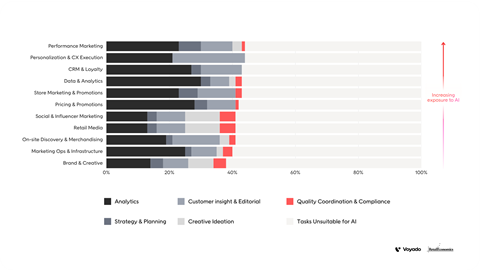
An example of AI’s impact on leading retailers’ workflows was given by Next in their financial results last week. The UK fashion giant said that declining technology and contact centre costs were declining as a proportion of sales after the rollout of AI in these departments.
“In most areas, teams are using co-pilot software assistants and deploying large language models to document new specifications. We are already seeing material improvements in productivity and quality as a result, delivering new software faster and for less cost,” Next said, adding that the aim was to incorporate “agentic AI” into its software development process, automating much more of the workflow.
“This is still young technology. Generative AI has already delivered significant efficiency gains, but it’s agentic AI, built on the right data foundations, that will prove real commercial value,” said Felix Kruth, chief product officer at Voyado.
In early March, Anthropic, developer of the Claude AI model that has proved particularly popular with software developers, released its own study into the labour market impact of AI.
It found that 74.5% of tasks completed by computer programmers and 70.1% of tasks completed by customer service representatives had “observed exposure” to AI disruption, a figure derived from both the theoretical capability of large-language models (LLMs) and real-world usage data.
The top reasons given in the Retail Economics/Voyado study for delayed progress on AI were “skills, resistance, and data compliance concerns.”
“The retailers that succeed will be those building the right data foundations, skills, and operating models now, as AI becomes a core requirement for competing effectively in retail,” added Lim.





No comments yet