














Geopolitical disruption, rising customer expectations and omnichannel complexity are transforming logistics into a strategic imperative. Tritax Big Box REIT head of asset management Petrina Austin believes retailers must prioritise infrastructure planning or risk being constrained by outdated systems
In a game of fine margins, the battleground has moved. No longer confined to the shop floor or even online, it is now behind the scenes. Less glamorous, but far more decisive. Logistics networks are where retailers can cut through and set themselves apart.
Traditional strategies focused on product, price and customer experience are no longer enough. Today, competitive advantage is increasingly determined by the strength of a company’s logistics network.
Geopolitical uncertainty, rising expectations for faster deliveries and instant gratification are piling more pressure on retailers’ supply chain infrastructure. With 80% of UK businesses already experiencing, or expecting to experience, direct impacts from the unrest in the Middle East1 – such as higher shipping and energy costs – productivity and future resilience are more critical than ever.
Against this backdrop, logistics infrastructure can no longer sit downstream of boardroom decision-making. Discussions around space, power, labour access and infrastructure planning must be prioritised earlier in retail growth strategies.
The rise of omnichannel marketplaces, spearheaded by companies like Next and Marks & Spencer, alongside rapid growth in social commerce via platforms like TikTok Shop, has transformed how retailers reach and serve customers.
L’Oréal Paris generated more than $1m in sales during one UK TikTok Shop event, a 466% increase in weekly purchases.2 To support this demand, L’Oréal operates three specialised distribution centres delivering products for over 30 brands across multiple retail channels, beauty salons and ecommerce platforms.3
Examples like this reinforce a critical shift; logistics is no longer a support function. It is a crucial driver of customer experience, operational resilience and competitive performance. Yet it’s easy to treat logistics as an operational necessity rather than a strategic advantage.
This gap is becoming increasingly exposed. In our 2026 Future Space Survey, 59% of retailers reported a need for more logistics space over the next three years, with a particular focus on build-to-suit assets. This demand, coupled with longer development timelines, increasing competition for well-located sites, and rising power requirements, reinforces the need for retailers to engage in infrastructure and property strategy earlier to avoid future operational constraints.4
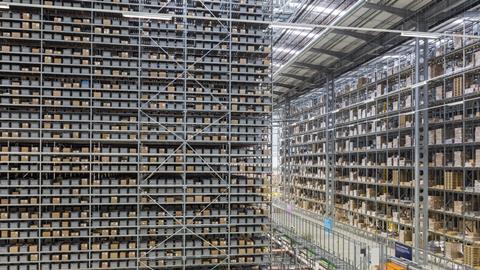
M&S’ supply chain consolidation is a leading example of how to streamline outdated logistics networks, migrating from over 100 small legacy depots to a handful of highly automated, build-to-suit regional mega-warehouses to cut costs and drive long-term growth.5 For many retailers, however, optimising existing assets through targeted expansion and efficiency audits may be a more effective solution than full relocation.
But physical infrastructure is only part of the equation. As logistics networks become more technologically advanced, workforce strategy becomes more important, not less. Our research shows that 58% of retailers expect demand for skilled labour and technicians to increase over the next three years,6 set against an ageing workforce with ~55% of HGV drivers over 50.7
Retailers, including Next and Amazon, are investing in training, apprenticeships and workforce development to address these gaps. These are not just operational decisions; they are strategic priorities requiring board-level commitment. Future-ready logistics assets must support both operational performance and long-term workforce retention.
The question for retailers is no longer just what to sell, or even where to sell it, but whether their infrastructure can keep up. Those that recognise logistics as a strategic capability today will set the pace. Those that don’t risk finding their growth ambitions constrained by the very systems designed to support them. In today’s market, logistics is no longer simply supporting retail strategy; it is increasingly defining it.

Petrina Austin is head of asset management at Tritax Big Box REIT.
References
1. British Chambers of Commerce: https://www.britishchambers.org.uk/news/2026/05/firms-warn-of-rising-costs-from-iran-crisis/
2. WPP Media: https://www.wppmedia.com/news/interview-guillaume-totis-loreal-tiktok
3. Evenbreak: https://www.evenbreak.com/employer/c107a927-cae5-4a68-93bf-2f60ce3b01d0/loreal-uk/hub/l-oreal-uk-and-ireland
4. Tritax Big Box, Future Space Report: https://www.tritaxbigbox.co.uk/news/future-space-census-shows-confidence-in-improving-market-conditions-in-the-il-sector-labour-technology-and-power-in-focus/
5. M&S, Annual Report: https://corporate.marksandspencer.com/investors/our-performance-updates/2026-annual-report
6. Tritax Big Box, Future Space Report: https://www.tritaxbigbox.co.uk/news/future-space-census-shows-confidence-in-improving-market-conditions-in-the-il-sector-labour-technology-and-power-in-focus/
7. EOS Training, The UK HGV Driver Shortage: Causes, Impacts & Solutions