














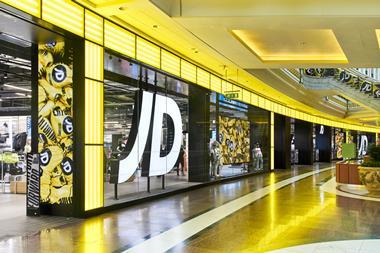
JD has warned markets that its profits will be among the lower end of market expectations due to rising unemployment and volatile customer sentiment among its core demographic.
The sportswear giant saw group like-for-like sales drop 1.7% during the 13 weeks to November 1, 2025, while organic sales increased 2.4%.
For the 39 weeks to 1 November, like-for-like sales dropped 2.2%.
Almost all of JD Sports’ core markets saw a drop in like-for-like sales during the period, with North America slipping 1.7%, Europe down 1.1%, and the UK down 3.3%, while sales in Asia Pacific increased 3.9%.
The retailer said in a statement to markets that it expected profits to be within the bottom end of guidance, stating: “Recent indicators have shown incrementally weaker macroeconomic and consumer external data points in our key markets. We are particularly mindful of the pressures on our core customer demographic, including rising unemployment levels, as well as near-term volatility around consumer sentiment.”
Its UK performance was impacted by “unseasonably warmer weather in September”, which dampened sales of outdoor apparel coming into autumn, and “softness in footwear” which was driven by end-of-cycle product lines and tough comparatives in women’s trainers.
There was a similar picture of softness within footwear in North America, which represents 37% of its Q3 sales. The retailer is currently managing the conversion of the Finish Line fascia to JD, “where market-driven promotional intensity remains higher than normal in the short term”.
JD also said it was on track to generate strong free cash flow and complete £200m of share buybacks in the next financial year.
JD Sports chief executive Régis Schultz said: “We continued to make good progress with our strategic objectives in the quarter, against what remains a tough market backdrop. Our multi-brand and cross-category approach, and agility in responding to changing customer trends, are helping us to offset known consumer and industry headwinds. We are also controlling our costs and cash well through our focus on operating and financial discipline.
“North America delivered an improved like-for-like sales trend in Q3, alongside resilient trends in Europe. The UK had a better organic sales performance, supported by the continued success of our new flagship store at the Trafford Centre in Manchester. By category, our apparel range is resonating well with customers, providing us with an opportunity for growth in underserved key markets. In footwear, notwithstanding known end-of-cycle product headwinds, ‘running’ remains a key trend for our customers, and we have a strong product line-up in this area going into our busiest trading period.
“We are leveraging the significant investments we’ve made in technology to upgrade our e-commerce platforms across the group, which are starting to deliver measurable benefits and will serve as a key foundation for the next phase of our digital and omnichannel growth. We also continue to make strides in optimising the group’s global supply chain. Leveraging state-of-the-art technologies, during the period we launched automation at our distribution centre in Heerlen, the Netherlands - a key milestone in our growth and profitability plans for Europe.
“We are navigating a year of volatility in external factors with disciplined execution, reflected in a solid Q3. In the near term, as we enter an important trading period, we are mindful of recent weak macro and consumer indicators in our key markets. These lead us to take a pragmatic approach for our FY26 profit outturn. We remain confident in the overall positive trajectory for our industry and JD Group over the medium term, and this is well reflected in our commitment to enhanced shareholder returns.”



No comments yet