

















JD Sports said it has started the year “in line with expectations” but warned that its guidance for the 2026 financial year excludes the pending impact of changes to tariffs amid a “volatile” trading environment.
JD Sports posted like-for-like revenue growth of 0.3% for the 13 weeks to February 1, 2025, in what the sportswear giant called a “challenging market”.
Fourth quarter organic revenue growth was also up 5.6% thanks to a “strong performance” in Europe.
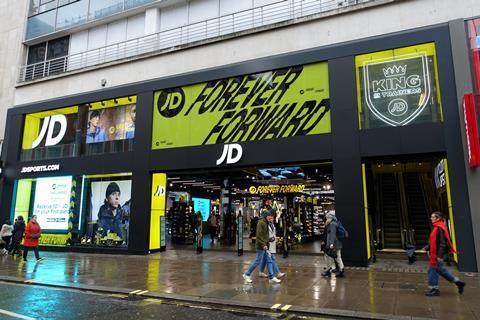
For the full year, JD’s like-for-like revenue also grew 0.3% in line with the previous guidance of “broadly flat”, while organic revenue growth was up 5.8% thanks to “strong growth” across North America, Europe and Asia Pacific.
JD Sports finished the year on a total store estate of 4,850, up from the start of the year thanks to the addition of 1,485 Hibbett and Courir-acquired stores.
Looking ahead, JD Sports said it has started the 2026 financial year “in line with expectations” despite “volatile” trading in its key markets but said it expects like-for-like revenue to be below the 2025 financial year.
The retailer also emphasised that current guidance excludes any impact from the ongoing changes to tariffs and said in a statement: “We note the proposed changes to tariffs announced last week. At this stage, the outcome of these developments is uncertain. We are in regular dialogue with our brand partners but it is too early to comment on the potential sector impact.”
The group said its acquisitions of both Hibbett and Courir traded in line with expectations during the fourth quarter and said that the acquisitions made in 2025 will drive revenue growth in 2026.
JD Sports expects to open around 150 new stores in 2025, as well as 100 relocations during the year alongside around 50 closures across Eastern Europe.
Alarms ring over global sportswear slowdown
JD Sports also warned that it expects global sports fashion to “grow at a slower rate over the medium term” and that it was adapting its plans to “capitalise on our growth opportunities and investments” as a result.
In terms of the changes it has made to its medium-term strategy, JD Sports split it into four strategic pillars.
With JD First, it said its new plans in the medium term were to build brand awareness in North America “through the opening of new stores and completing the conversion of Finish Line stores to JD” and to improve European profitability by focusing on “key markets and delivering supply chain benefits”.
With regards to the UK, JD Sports said it wanted to improve “productivity through investment in our estate and delivering cost efficiencies”.
The retailer said it also wanted to capitalise on its “multi-fascia customer proposition” in the US to “grow ahead of the market”, as well as accelerate the growth of the Courir brand in Europe and “sharpen” its UK outdoor business.
JD Sports also promised to “deliver benefits from our significant supply chain investment” over the last two years and to “integrate US supply chain and systems on time and to budget delivering targeted synergies”.
The retailer also said that it is now moving into a “lower phase of capital investment, with no material M&A opportunities in the pipeline”.
JD Sports chief executive Régis Schultz said: “JD operates within an attractive, long-term growth market and we are well positioned to continue growing market share. We have strong brand partner relationships and an agile, multi-brand model which allows us to drive, and respond quickly to market trends. We are highly cash-generative and disciplined in terms of our capital allocation opportunities.
“We have made significant strategic progress over the last two years: we have accelerated the growth of the JD brand, particularly in North America and Europe; we have continued building a global sports fashion powerhouse through the acquisitions of Hibbett and Courir, taking full ownership of ISRG in Iberia and MIG in Eastern Europe, and disposing of around 30 non-core businesses; we have upgraded our global supply chain; and we have built the required infrastructure and governance for a group of our scale.
“Reflecting slower market growth and the investments we have made in our supply chain and infrastructure, we are updating our medium-term plans to capitalise on our organic growth opportunities in North America and Europe, deliver productivity and efficiency benefits from the investments, and utilise our strong cash generation to deliver improved returns for our shareholders.”



No comments yet