
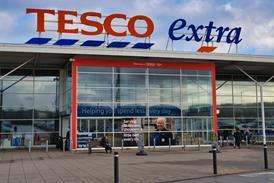








Despite reporting incredibly strong trading figures for the last financial year, Tesco slashed its profit forecast for the coming year. Is the supermarket giant being overly cautious though?

Tesco’s Ken Murphy is praying for peace while preparing for war.

Despite surging profits and sales for the 52 weeks to February 22, 2025, Tesco today slashed its guidance for this year to between £2.7bn and £3bn—below the flat consensus of £2.9bn many city analysts had predicted.

Ken Murphy Tesco

Source: Tesco

Tesco chief executive Ken Murphy: ‘We’ve led the charge in terms of making sure customers get great value’

Murphy said the lower guidance was to ensure that Tesco had both the “flexibility and firepower” to respond to whatever may happen this year.

And, as Murphy pointed out, there are plenty of potential headwinds that the supermarket giant, and the wider sector, could well be pushing into.

Despite slashing over £500m in costs from the business in the 2024 financial year, Murphy says the grocery giant plans to cut the same amount again this year as it bids to react to the coming increase in national insurance contributions and to continue to invest in prices for customers in the event of it being forced to fight a price war with its rivals.

Asked whether further cost-cutting would put jobs at risk, Murphy wouldn’t rule them out. But added: “We’ve ended this financial year with more people than we started. So, I think we’re using those savings to drive growth.

“That growth has come, and that’s allowed us to grow the business and provide more opportunities. We never rule out job cuts. It will be naïve to do that, but at the same time, I think our track record speaks for itself.”

Price war

Talks of a supermarket price war were sparked last month when Asda chair Allan Leighton promised that the supermarket would make its biggest price cuts seen for 25 years to make it more competitive with consumers and spoke of having a “significant war chest” for investment.

While Murphy wouldn’t say whether or not he thought the UK grocery sector was already in a price war, he said he would leave himself the financial muscle to ensure that Tesco remains competitive, whatever might happen.

“The grocery market is an intensely competitive one in the UK, and I think I would point to a general intensification of competition across the board. Clearly, there have been statements made recently by one competitor, but in truth, we’re just seeing a very competitive market, and we’ve led the charge in terms of making sure customers get great value.

“Whatever the competitive environment and whatever comes our way, we’re capable of dealing with it”

“We are seeing an intensification [in competition] across value. And I think our competitors are clearly looking to defend against the market share gains we’ve been taking. But I think our momentum speaks for itself in terms of our positive share gains.

“So, the announcement we’re making today [on lower profit guidance] is being made from a position of strength. Really, what we’re saying is that whatever the competitive environment and whatever comes our way, we’re capable of dealing with it”.

While Murphy insists lowering the guidance is the right thing to do for the business, the announcement today sent Tesco’s share price tumbling.

Bernstein analyst William Woods questioned Tesco’s decision, calling it “caution in extremis, given that we don’t think there is a price war”.

However, Shore Capital analyst Clive Black was more supportive of Tesco’s announcement. “The group is executing very well and giving itself wiggle room to be competitive,” he notes. “The market leader is not being complacent, and the jeopardy has been removed by the recent stock markdown.”

Impact of tariffs

Of course, it’s not just the spectre of a newly flush Asda kicking off a price war and the increase to national insurance contributions that Tesco has to deal with.

Over the last few days, the US and president Trump had been ratcheting up tariffs on just about every country in the world—causing global stock markets to plummet and sparking fears of a worldwide recession.

In trademark erratic style, Trump announced a 90-day freeze on added tariffs to the majority of the world. However, he turned the screws on China, ratcheting US tariffs on the manufacturing superpower to 125%.

While China has responded, much of the rest of the world — including the EU — has pulled back from the brink of slapping retaliatory tariffs on the US.

And while the financial markets have recovered somewhat off the back of Trump’s U-turn, the world is left holding its breath and wondering what Trump and his advisers will do next.

Murphy said that he didn’t expect a major hit to Tesco’s food business from international tariffs, adding: “We continue to make our own preparations, and we don’t believe that the impacts of the tariffs are significant at this stage for the Tesco business”.

“Things are moving very quickly, and it’s very hard to figure out what that means. So, I think we’ll continue to watch it very closely”

And while he did say he could see potential knock-on effects to global shopping, Murphy insisted Tesco’s UK-focused supply chain would help shield the supermarket from most disruption.

“We’ve seen no impact for now,” he said. “The majority of our product comes from UK suppliers, and we’re coming into a season where that increases.”

Only 7% of Tesco’s products are non-food, he said. “Therefore [there is a] relatively small impact for Tesco.

“Things are moving very quickly, and it’s very hard to figure out what that means. So, I think we’ll continue to watch it very closely.”

While some city analysts and investors clearly don’t agree with Murphy’s caution, the next few weeks and months are likely to be incredibly turbulent—even by the standards of the last few years.

Murphy is clearly leaving nothing to chance and, should a true supermarket price war kick-off, he looks ready for the fight.