

















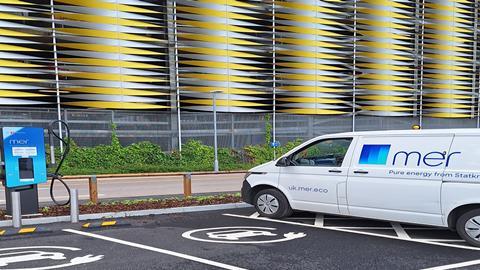

Switching to EVs early is not just about sustainability, says Mer. Discover how being an early adopter can provide both financial and operational gains
The shift to electric vehicles (EVs) is already proceeding at a rapid pace. For businesses, adopting EVs early presents a unique opportunity to gain a competitive edge while future-proofing operations.
These pioneering organisations benefit not only from sustainability gains, but also from financial and operational advantages that late adopters might struggle to capitalise on.
Long-term costs
At face value, EVs are more expensive than their diesel counterparts, but this viewpoint fails to account for the savings in the long term.
EVs have fewer moving parts than diesel vehicles, significantly saving on maintenance costs. Initial fears of battery life expectancy have reduced, since most manufacturers offer robust warranties in a show of confidence.
By switching early, retailers can start compounding these savings sooner, therefore achieving a lower total cost of ownership across the fleet.
Further savings for early adopters can be gained by taking advantage of the numerous government grants and tax incentives. Funding is limited for these initiatives, so those who move fast are more likely to gain from them.
Charging infrastructure isn’t built in a day
The transition to EVs requires planning. This can range from installing the chargers, to training staff and rethinking your operational strategies.
Businesses that make the switch early have more time before the 2035 OZEV deadline to take a phased approach, avoiding the panicked rush of those who left it too late.
Early adopters will have the time to run pilot schemes, such as making the switch at a single depot or selecting less critical routes for the initial stages.
Due to the complexity of the transition and lack of internal expertise, it is important for retailers to select an EV charging partner to help guide them through the process of switching to EVs.
An experienced partner will identify which depots and fleet segments might be best to make the change first, before advising on the right hardware to always keep your fleet operational.
Ahead of the curve
Organisations that delay their fleet transition risk losing money, as they will either have to make a last-minute dash to convert their fleet or risk hefty compliance costs and restricted access in ever-expanding low-emission zones.
Planning can not only help future-proof your business but mean you are ahead of the pack.
To avoid this, engage with an EV charging partner such as Mer early. For the past 9 years we have been busy helping over 700 organisations such as IKEA and DX Delivery in switching their fleet to EVs.
If you want to discover more about the principles of EV charging for depots, download Mer’s latest e-guide.