















High street retail chains are in general no better off from yesterday’s new set of business rate measures than they would have been had the multipliers simply risen in-line with inflation as per usual, detailed analysis by my colleague Francisco Uranga has found.
The chancellor yesterday lifted the rateable value threshold at which businesses start paying rates to £18,000, meaning 70,000 additional properties now pay nothing. He also pledged a two-year real-terms freeze in bills for all retail, hospitality and leisure properties (RHL).
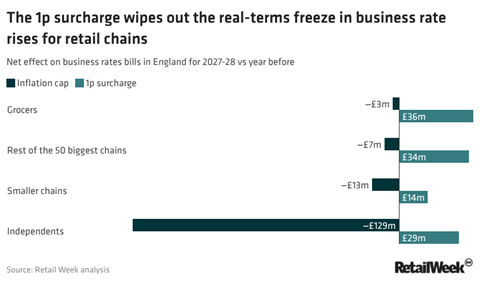
Francisco’s analysis, based on some painstaking pre-Budget matching up of all relevant properties in England with leading retail chains, found that the net effect of the new policies skews heavily towards independent and small retailers.
On that real-terms freeze, multipliers typically rise each year with inflation. What makes that policy a giveaway is that last year was a revaluation year, where rates bills were adjusted to reflect what is seen as the market value of each property in the country.
The government offered transitional relief to businesses whose property bills increased by a huge amount, capping increases by 30% for the highest value locations this year, with scope for increasing it by 25% plus inflation over the next two years. The small subset of retail chains whose properties still had further rates bill rises to come, will have these increases now capped to inflation.
It all sounds good, but to fund these staggered rises last year, the government added a 1p supplement on all other properties not receiving transitional relief or the relief offered for small businesses. This will now be extended for a further two years and Francisco found that for retail chains, this all adds up to higher bills (in nominal terms).
The chart below makes this especially clear with grocers and large chains having any relevant capped rises quickly drowned out by the 1p surcharge. Independent retailers meanwhile are the ones who see most of the benefits.
British Retail Consortium chief executive Helen Dickinson described the policy as “a smoke and mirrors announcement on business rates.” For chains and grocers at least, that does look to be an accurate assessment. Let’s look at what else happened yesterday.
Online marketplaces will now be responsible for collecting VAT from retailers selling on their platforms. This means platforms like eBay, Temu, Shein and Alibaba will now need to introduce mechanisms to collect payments from any retailer making sales on their platform above £90,000 (The VAT registration threshold). Amazon was already in favour of the changes and Monica Ariño, director of UK public policy, called it an “important step towards closing a loophole exploited by bad actors”.
The measure will come into force from October next year, the government said, with its policy costings showing it expected to raise £1.27bn over the next five years. That revenue will more than cover the £1.18m net cost of its new business rate measures (excluding additional revenue from vape shops). The Office for Budget Responsibility (OBR) did note in its forecast though that the revenue from the new marketplaces policy had high levels of uncertainty.
A 12-month timeframe from announcement-to-rollout probably looks pretty tight for affected businesses. The summary report of the consultation held around the new rules this summer found a “common view” among stakeholders was that a year would likely be optimal from the publication of detailed guidance to get ready for implementation. Secondhand sales will be exempt, a move not so popular with the British Independent Retailers’ Association.
The national living wage and national minimum wage for 18-20-year-olds will both increase by 3.9%, as trailed widely before the Budget. “Today’s announcement adds another £2bn on top of the £6.5bn in additional employment costs that retailers have faced over the last two years,” said Dickinson.
The double disappointment on labour costs was that the policy came with no further detail on action on young people out of work. The chancellor only said that Alan Milburn’s report on NEETs (young people not in employment, education or training) will be published next month. Retailers had called in advance for a rise in the national insurance contributions (NICs) threshold to encourage job creation among under-25s.
And now to the OBR forecast which certainly contains some depressing lines. It now expects the rise in energy bills to drive household disposable income down by 0.6% next year with no real-terms earnings growth at all. The watchdog predicts that disposable income in 2030-31 will now sit just 2% above its pre-pandemic level. That kind of performance is “pretty unusual in British history,” said David Miles of the OBR.
Back to business rates which by the end of the decade will be distributed fully to local authorities by the end of the decade. Retail has often complained about the tax not being used to fund local high streets, which is a criticism that will soon no longer hold water. There were also new measures on helping local authorities crack down on businesses avoiding ratepaying.
How has the sector reacted? My colleague Hugh Radojev has the answers here.
What else has been happening? Frasers finally edged over the line to take a majority stake in premium German brand Hugo Boss. Its other takeover target, Australian chain Accent Group, once again pushed back in a statement to the Australian Stock Exchange.
Recent financial updates (all changes on the same period the year before unless stated):
- Dusk (+19% revenue, six months to September 30)
- Revolution Beauty (-2% revenue but losses down, six months to August 31)
- The Very Group (+3.4% adjusted EBITDA, year to June 27)
- Debenhams (£28.3m pre-tax profit vs £17.9m loss last year, six months to August 31)
Thanks for reading. You can email me at george.arnett@retail-week.com if you have any questions, comments, ideas, etc.
See you next week.
George Arnett, intelligence and insights editor
No comments yet