













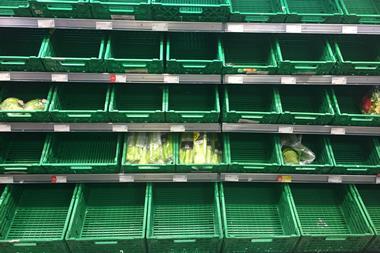
The UK food industry has called on the government to waive aspects of competition law to allow businesses to coordinate and direct supplies with one another in the event of a no-deal Brexit.
The Food and Drink Federation has said in the event of the UK leaving the EU without a deal in October, the government should provide assurances that the Competition and Markets Authority (CMA) will not fine companies for collaborating to “tackle likely shortages”.
FDF chief operating officer Tim Rycroft told the BBC: “In the event of no-deal disruption, if the government wants the food supply chain to work together to tackle likely shortages – to decide where to prioritise shipments – it will have to provide cast-iron written reassurances that competition law will not be strictly applied to those discussions.”
Rycroft said the FDF had asked for reassurances at the end of 2018 but “despite support from the Department for Environment, Food and Rural Affairs, we’re still waiting”.
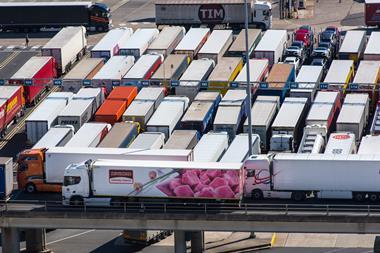
The BBC quotes “the boss of one leading retailer” who said: “At the extreme, people like me and people from government will have to decide where lorries go to keep the food supply chain going. And in that scenario, we’d have to work with competitors and the government would have to suspend competition laws.”
The government has waived competition laws in the past – three in relation to the defence industry and another regarding the oil and petroleum industry.
However, former head of the Office for Fair Trading John Fingleton warned: “The last time something like this happened was in relation to dairy prices in 2001 when companies incorrectly thought government words about higher prices for dairy farmers would protect them from competition law. It did not.”
A number of retailers have said the October 31 deadline for Brexit is the worst possible time for the food industry.
Former Sainsbury’s boss Justin King waded into the debate today, when he said: “There is, at best, less than ten days of food in the system at any one time and October is just about the worst time to be generating this kind of crisis.
“The warehouses are all at capacity ahead of Christmas and as we hit the autumn we are more reliant on imported fresh food, as our growing season comes to an end.”
Mike Coupe, King’s successor at Sainsbury’s, said last month that the deadline was “about as bad as it gets” as it will be gearing up supply chains and stocking up for Black Friday and Christmas.
“You couldn’t choose a worse date,” Coupe said. “The timing, as in October 31, is bang in the centre of when we are gearing up our supply chains and our stocking for all of the main Christmas events – Black Friday and then the main Christmas trading season.”
That view was echoed by Tesco boss Dave Lewis, who said the October deadline was “much more challenging than March” for the sector.
“We come out of a very busy Halloween period in October and we would be building stock for the Christmas peak. The capacity in the supply chain in the UK will be more challenged in October than it was in March,” Lewis said.
Boris Johnson’s newly formed government has repeatedly said the UK will be leaving the EU on October 31 “come what may”.


No comments yet