



















They say that people have short memories but it is only two years ago since the publicly-quoted Clinton Cards and Game Group went bust in ignominious fashion, losing their investors a lot of money.
They say that people have short memories but it is only two years ago since the publicly-quoted Clinton Cards and Game Group went bust in ignominious fashion, losing their investors a lot of money.
So at first sight it may seem strange that Clintons’ rival Card Factory has just listed on the stock market and that Game has announced that it too intends to float.
Interestingly, despite the growth of the digital games market, there is still a big ‘physical’ market in video games, just as the greetings card market has not collapsed in a world of emails, instant messaging, e-cards and ever-increasing postage prices.
In the greetings card market the ground is increasingly shifting towards the supermarkets and discounters such as Card Factory. WHSmith and the charity shops are chipping in as well by offering increasingly good ranges of cards.
Clintons was simply too big to withstand those structural changes in the market and it was saddled with a very expensive high street store portfolio, having been one of the great ‘space bandits’ of the mid-1980s.
Rival Card Factory was always much more profitable, reflecting the much lower rents that it pays in more secondary locations and the extra gross margin obtained through in-house card printing and manufacturing. It looks like EBITDA will be as much as £88m or so in the year ending Jan 2015, on sales of £350m.
Card Factory has an unbroken track record of like-for-like sales growth each year since it opened its first store back in 1997, and the group intends to expand its store portfolio organically from its existing 739 branches towards about 1,200 stores over the next 10 years, at a similar rate to the its historical rate of organic openings - 50 a year.
So Card Factory was actually sold as ‘a growth stock’ in the IPO process, rather than as a mature cash generating business but, alas, the stock market was not convinced. The shares were priced at the bottom of the 225p to 300p range and have fallen well over 10% in the first few days of trading.
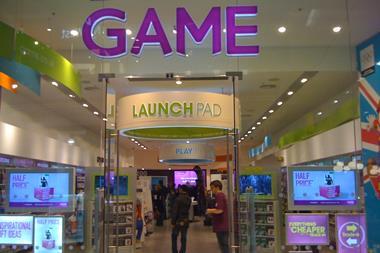
So what about Game Group? Well, the group has been renamed Game Digital to reflect its new multi-channel approach, and the business has been streamlined.
The once big operations in France and Scandinavia got lost in the administration process and the core business is now the UK and Spain, comprising 560 stores - down from 874 as at January 28 2012.
And Game enjoyed a fantastic Christmas with an astonishing 90% increase in like-for-likes, although it’s hard to tell at this stage whether that was just because it’s riding the huge pick-up in the video games market after the launch of the new Playstation and Xbox game consoles, or whether it reflects better management under chief executive Martyn Gibbs.
Either way, for the 52 weeks ended January 25 2014, Game generated revenue of £816m and adjusted EBITDA of £47m, so it has enjoyed a remarkable recovery, benefiting from the turn-up in the video games cycle as well as lower costs and better gross margins. It looks set fair for the next couple of years.
This is obviously, however, a very cyclical business, as investors know to their cost. This is no doubt taken into account in the mooted £400m valuation.
Obviously it’s easy to be cynical about Game, given the burnt fingers that investors are nursing, but the ‘new’ Game did get rid of a lot of poor stores in the administration process and is more advanced in multichannel, so it will be interesting to see how it’s received.
Its City backers must be confident if they’re pressing ahead with the IPO, despite more tricky stock market conditions.
In the light of the initial fall in the Card Factory share price, the Sunday Times mocked the management share sales in the IPO with the cruel headline “Dear Card Factory investor: Sorry, we’ve just cashed in”.
Time will tell whether the makeover of such a cyclical old beast as Game as an exciting new growth business is successful.
If it is not, there will no doubt be cruel headlines mocking its private equity owner’s share sales: “Dear Game Digital investor: Sorry, we’ve just cashed in”.
About Nick Bubb
Nick Bubb has been a leading retailing analyst for over 30 years. He is a well-known commentator on UK retailing and is a founder member of the influential KPMG/Ipsos “Retail Think-Tank”.



No comments yet